
The Sonny Branum Story
BORN TO ENDURE
━ From Issue 01 · May 2026
At 6’5” with a fearsome face tattoo and a build like Darth Vader, Sonny is one scary-looking dude.
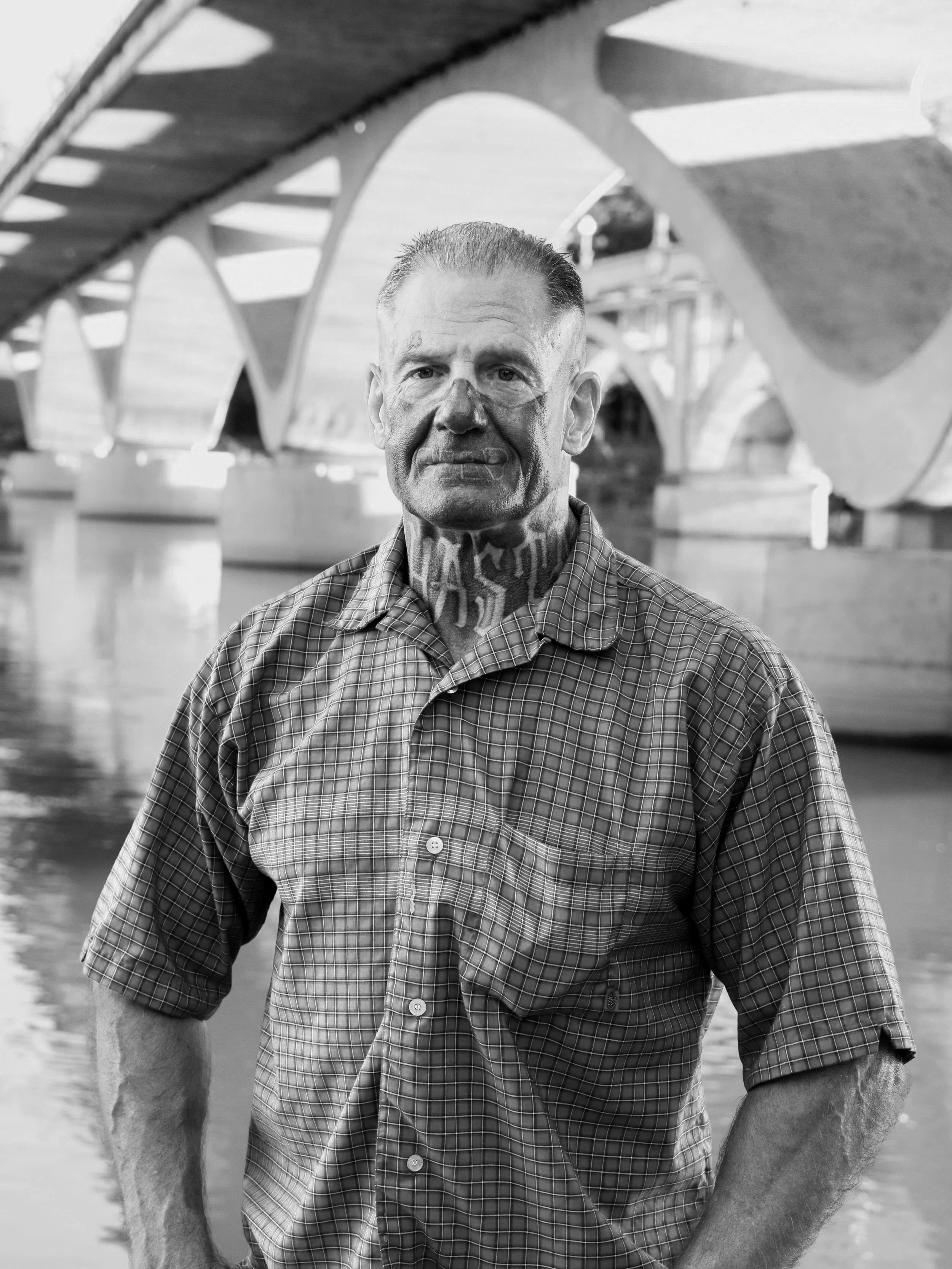
Sonny Branum at the Sundial Bridge, Redding. After 35 years incarcerated, he now spends his weeks mentoring men in addiction recovery at the Good News Rescue Mission.
If you were an average Joe who saw Sonny walking down the street, you'd be tempted to dart into a dark alley. Because in the moment, that could just feel like the safer place to be.
But while the 61-year-old may slightly resemble Scabrous Scrotus of Mad Max and sound, on occasion, like a banshee rooster, this Indiana transplant is anything but. His disruptive bark is due to Tourette's Syndrome — or as he will correct you — a severe neurological vocal tic that causes him to yell out involuntary sounds. He can also stomp his feet so forcefully you're sure he'll crash through the floor. Those vocal and body tics can't be helped, but in tandem with his intimidating looks, it doesn't exactly convey a "Hire this guy!" first impression.
But then you get to know Harrison LéRoy Branum, III, nicknamed "Sonny." Despite his full name sounding like a 1930s presidential candidate, he never ran for anything — except perhaps for the nearest exit when being chased by the law. But if you can get past the first three hurdles — the intimidating looks, the unsettling screaming and stomping, and his criminal past — you'll find a hidden gem of a man.
Sonny's not a "we-were-dirt-poor, my-daddy-beat-me-and-my-momma-was-a-drunk" kind of story. He had a normal childhood. Other than his backside occasionally being "whupped" according to the discipline style of that time, he suffered no abuse by either parent. What Sonny did suffer at age 12 was profound grief after his father was killed in a trucking accident. To this day, he still experiences waves of survivor's guilt. If he had been with his father, he thinks, he could have kept him awake. Of course, that's not rational. Sonny agrees, but that kind of guilt can linger for a long time.
To the Max
After moving the family to California, Sonny's mother worked a series of low-paying jobs. Despite severe hardships, she managed to make ends meet — with the help of some backyard pigs and chickens that snorted and clucked their way to the dinner table.
At 16, deprived of a father figure, Sonny started doing drugs. His heavy use of meth induced a state of paranoia, making it even more difficult to find employment. Whiskey calmed him down, but it was always a balancing act. Soon after, he opted for a career as a sales-related chemical engineer. "That's a polite way of putting it," says Sonny.
Eventually, Sonny was arrested for possession for sales and, more seriously, criminal threats against his girlfriend. On one occasion, Sonny admits to his shame, those threats were carried out — elevating it to a domestic abuse charge.
In total he ended up serving 35 years behind bars. At least 12 of those years were spent in "the SHU" (pronounced "shoe") — a Special Housing Unit, or type of semi-solitary confinement. The reason was simple: Sonny had a temper. "In 1995 when I went in, they had a point system," says Sonny. "So, I got points against me for physical altercations. From there, I was sent to maximum security."
“I didn’t want to sit in there all drugged out. So, I exercised intently. I read books. In the only way I knew how, I was building a future.”
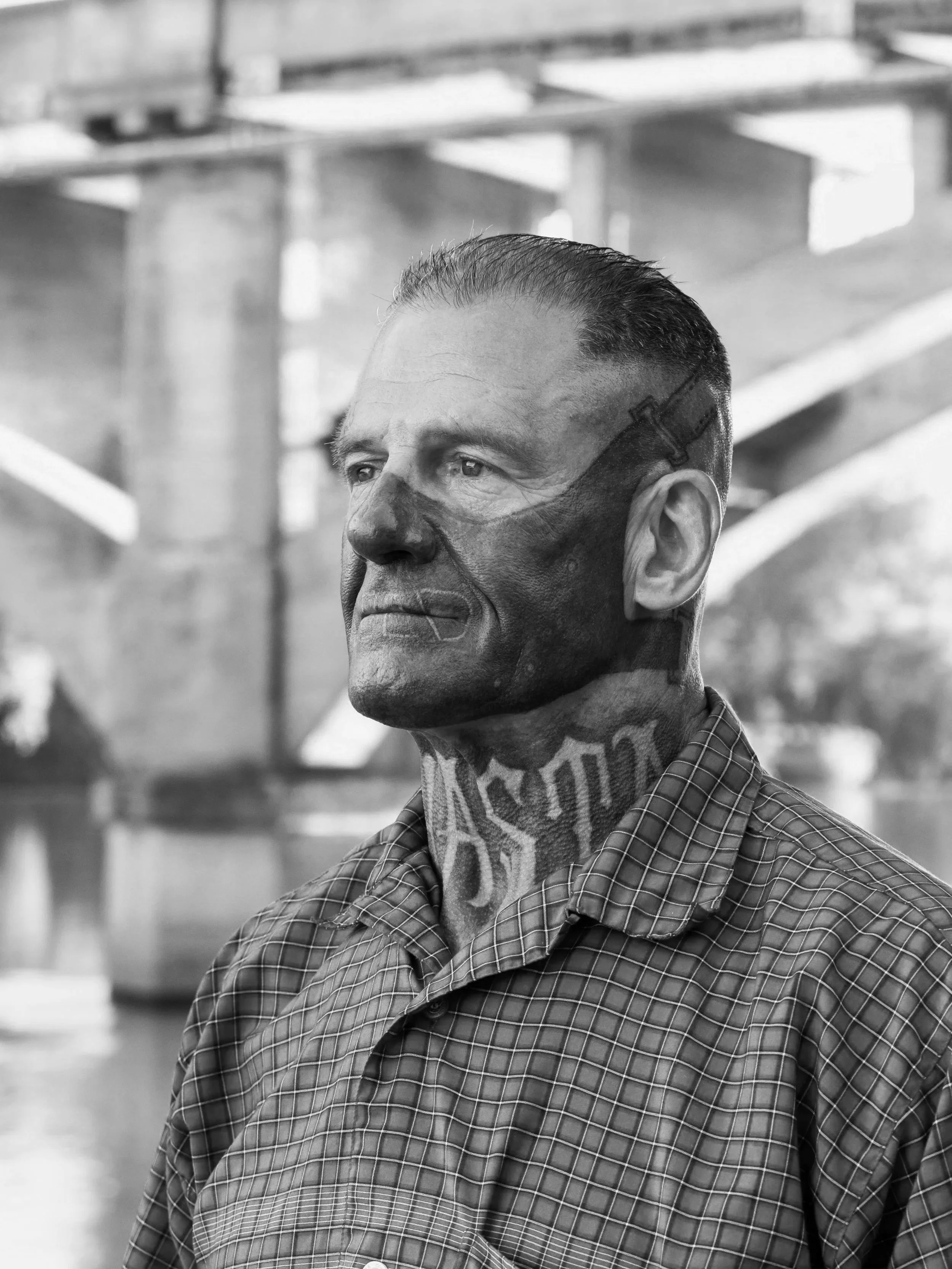
Sonny mentors men in the Good News Rescue Mission Recovery Program each week. "I'm called to a life of service," he says.
"Don't be an A-hole"
Fourteen years spent in semi-isolation is rough. Unlike many inmates, however, Sonny rejected drugs as a way to cope. It helped that he had no money to buy any. Instead, he turned to the "drug" of physical fitness and the mind-enhancing power of reading — inarguably a far healthier alternative to pumping his body full of chemicals.
"I didn't want to sit in there all drugged out," says Sonny. "So, I exercised intently. I read books. In the only way I knew how, I was building a future. And I practice that routine to this day. But prison is not the place to rehabilitate — to be prepared for a constructive life post release. They do the bare minimum. They don't feed us correctly. They don't provide vocational training. They don't provide an education."
Looking at Sonny's sculpted physique, you can easily see why nobody would mess with him. Sonny laughs at that notion, recommending a better way to keep from becoming a punching bag in the joint is "not to be an a-hole." In or out of prison, that's good advice.
Soul-wise, Sonny found himself spiritually torn. Raised in a Christian household, Sonny tried to nurture his spiritual beliefs but struggled with the tension between "turning the other cheek" and a prison culture that doesn't allow for wimps. Showing mutual respect is the best card to play, he advises. Stray outside your lane and break the protocols, and you've just sent an engraved invitation to a pummel party.
Stares, Glares and Gawks
It was a lesson Sonny must have learned well, as he is uncharacteristically polite and respectful — not something you'd expect from a career criminal. He's deeply ashamed that he ever abused or even threatened a girl, "because that's not how I was raised," says Sonny.
When asked how being locked up in "the SHU" for so long impacted him, Sonny replies, "It didn't make me bitter or mean. It just made me very forgetful. Even though I went out in the yard three times a week, I had no visitors, no contact with the outside world. So, you just naturally morph into a person who lives in a cell and slowly forgets about the outside. Prison becomes your world. In a way that's good, because the sooner a person becomes institutionalized, the quicker and easier their time goes."
In 2023, sometime after his final release, Sonny sought help for his body and vocal tics. While his fellow inmates were used to his uncontrollable outbreaks, on the outside he'd only get stares, glares and gawks — with some calling 911 thinking he was having a seizure.
What did turn out to be an unexpected asset post release was a mental health diagnosis, which allowed Sonny to access a pretrial diversion program in lieu of incarceration. This new law resulted in Sonny being placed in the Good News Rescue Mission Recovery Program. And that changed everything.
“You just naturally morph into a person that lives in a cell and who slowly forgets about the outside. Prison becomes your world.”
Tics Tats, Tics Tats
For the first time in his life, Sonny was fully accepted for who he was — tics, tats and all. Most importantly, he received unconditional love. Eventually, he let go of the tough-guy, "I'm-in control" prison persona, and began to discover his true identity. The Program's one-on-one mentoring, daily devotions and structured learning all combined to help him reflect on the consequences of his previous lifestyle while getting a glimpse of what his future could potentially look like. He liked what he saw.
Since graduating, Sonny has developed something else: self-respect. Despite only having held one brief job in his adult life, he's been working steadily in construction for the past six months. He carries a deep sense of gratitude for what the Program has done for him — a thankfulness that has translated into a specific purpose. Each week, Sonny visits the Mission to encourage other men in addiction recovery. He considers that an honor. "I'm called to a life of service," says Sonny.
Sonny may be called to a “life of service,” but he was born to endure. He restates this repeatedly during the interview. As to enduring the ongoing torture of his Tourette’s-like symptoms, thankfully, new medication has reduced those tics. Even more effective, he maintains, are the prayers from his fellow Recovery students. It’s difficult not to see this divine correlation— even for skeptics—given that right before entering the Program, Sonny had screamed for 90 days straight.
Who am I?
Sonny is a nuanced man. Tough looking and unflinching, he has a surprising mystical side. He's had more than a few otherworldly experiences — what he calls "phone calls from God." Like the time he glanced over at his fellow students and saw each of their faces shining like an angel's. "They were bathed in the brightest light!" recalls Sonny. "At the same time, I was seeing this, an overwhelming feeling of joy washed over me. And I kept hearing the words, 'This is a blessed place.' It was a real goosebump experience."
At 61, Sonny exudes both contentment and joy — a state of being we should all desire. But these didn't develop in a vacuum. They came out of suffering. And in that suffering, stripped of everything that gives a person a sense of belonging and purpose, he discovered the answer to the universal question, "Who am I?"
Who he is, he's discovered, is a human being worthy of God's love — no matter what he did or didn't do, or will or won't do in the future. And knowing that is what brings peace to his soul, blessing others in the process.
"For the first time in my life, I know who I am," says Sonny. "I live my life with the confidence of a man who's been forgiven — forgiven and loved by God. And there's such joy in that. I'm truly a blessed man."
What others are saying about this big softy
“Sonny was heads down all the way. He worked really hard to embrace computer and other skills he had never used before. He poured his whole heart into it.”
“Sonny really grabbed a hold of recovery and never looked back. Now he’s like a big brother to these guys in the Program. He’s had a huge impact on them.”
“Sonny may look scary to people, but when they really get to know him, they see a man who is soft and kind. He cares deeply about wounded people and wants to help them get better.”
“The day Sonny stopped pointing those proverbial three fingers at others and blaming them for his life is the day those fingers stretched out and became helping hands. He’s done a complete 180. He’s not a quitter. When he falls, he gets right back up again. He’s learned that meekness isn’t weakness, but rather strength constrained.”
Jenni Keast is a freelance writer based in Northern California. She's a lover of the Great Outdoors, photography, architecture and all things mid-century. Some of her favorite authors are G.K. Chesterton, C.S. Lewis, Leif Enger, Kazuo Ishiguro, and Walter Isaacson.
Issue 01 · May 2026
Read it the way it was meant to be read.
Sonny's full story — along with five others — lives in the print edition of HUMAN. Find a copy in Redding, Red Bluff, Chico, or Yreka.